
Solar farms across Africa are unlocking a silent revolution in agriculture by powering cold storage facilities that prevent up to 40% of harvested crops from spoiling before they reach market. This infrastructure pairing addresses one of the continent’s most persistent challenges: post-harvest losses that cost smallholder farmers billions annually and undermine food security across the region. By converting abundant sunlight into reliable electricity for refrigeration, these installations create direct economic impact in rural communities where grid access remains unreliable or nonexistent.
The connection between solar energy and agricultural preservation represents more than technical innovation. It’s a practical solution to overlapping crises. Africa loses nearly half its fruit and vegetable production to spoilage, primarily because farmers lack access to cooling infrastructure within the critical first 24 hours after harvest. Traditional diesel-powered cold storage proves prohibitively expensive for smallholders, while grid expansion lags decades behind need in many agricultural zones. Solar-powered systems eliminate these barriers by providing standalone energy generation exactly where crops are grown and harvested.
Recent deployments across Kenya, Nigeria, and Morocco demonstrate measurable results. Farmers using solar cold storage report income increases of 30-50% through reduced waste and improved market timing. These installations also create local employment, from facility operation to expanded distribution networks made possible by longer product shelf life.
Yet scaling this model requires navigating significant solar energy challenges including upfront capital costs, technical maintenance capacity, and integration with existing agricultural value chains. Understanding both the proven successes and persistent obstacles reveals how solar farms can fundamentally reshape African food systems while building energy resilience in underserved regions.
The Food Loss Crisis: Why Africa Needs Solar-Powered Solutions
Africa loses between 30 and 40 percent of its food production after harvest each year, a staggering waste that traps millions of farmers in poverty and undermines the continent’s ability to feed itself. Unlike losses during production, these post-harvest failures happen to crops already grown, watered and tended, representing wasted labor, water and land at a scale that would be unthinkable in regions with modern cold chain infrastructure.
The root cause is straightforward: most African countries lack reliable electricity access in rural areas where farms operate. Without power, there can be no refrigeration. Without refrigeration, fresh produce, dairy, meat and fish spoil within hours or days rather than weeks or months. Tomatoes rot in field-side piles. Milk sours before reaching market. Fish caught at dawn becomes unsellable by afternoon. Smallholder farmers, who constitute 70 percent of Africa’s agricultural workforce, bear the heaviest burden as they watch their harvests decay and their income vanish.
This isn’t just about individual farm economics. When fresh food rots before consumption, it drives up prices for consumers, reduces nutritional diversity in local diets, and forces countries to import food they could otherwise produce domestically. Evidence shows that solar cold storage reduces losses dramatically where it’s deployed, but coverage remains minimal across the continent.
Traditional grid extension moves too slowly and costs too much to solve this crisis at the pace required. Solar farms, however, can be built within months, operate independently of unreliable national grids, and provide the consistent power that cold storage demands. The technology exists. What’s needed now is deployment at scale.
How Solar Farms Power Agricultural Cold Storage Systems
From Large-Scale Solar Farms to Community Cooling Centers
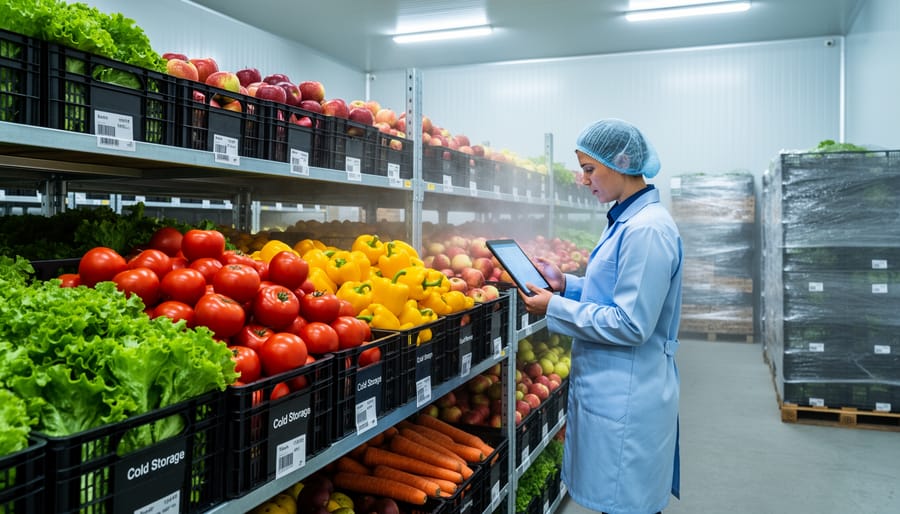
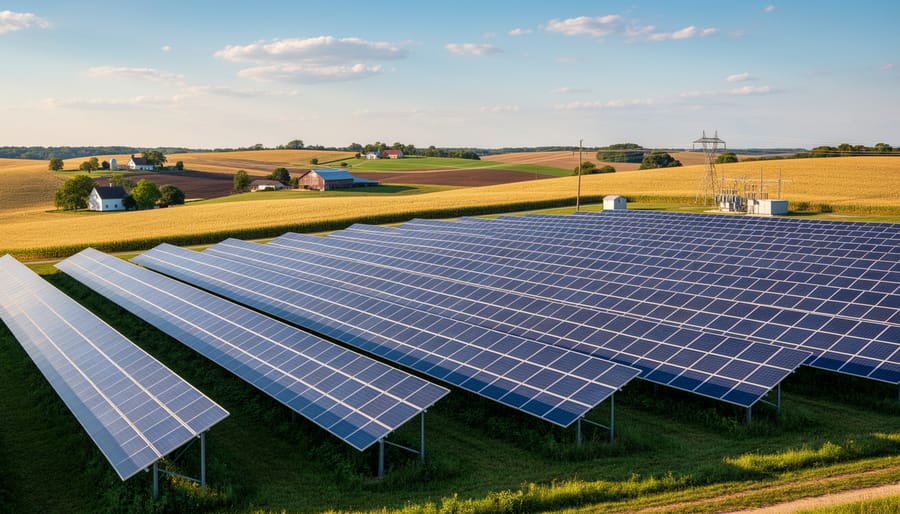
Solar farms in Africa operate across a remarkably flexible spectrum, from multi-megawatt installations serving commercial agricultural exporters to modular systems powering village-level cooling hubs. This scalability makes solar uniquely suited to Africa’s diverse farming landscape.
Large commercial farms typically connect to utility-scale solar installations, drawing reliable power for extensive cold chain operations that handle tons of produce daily. These facilities run sophisticated temperature-controlled environments maintaining precise conditions for flowers, fruits, and vegetables destined for international markets. The economics work because high-volume operations achieve rapid payback on infrastructure investments.
Mid-sized installations serve regional cooperatives, where groups of farmers pool resources to access shared cold storage. A 50kW solar array might power a community cooling center serving thirty smallholder farmers within a ten-kilometer radius. Farmers bring harvested cassava, mangoes, or leafy greens to the facility, paying modest fees per crate stored. This cooperative model distributes costs while giving smallholders access to technology otherwise beyond individual reach.
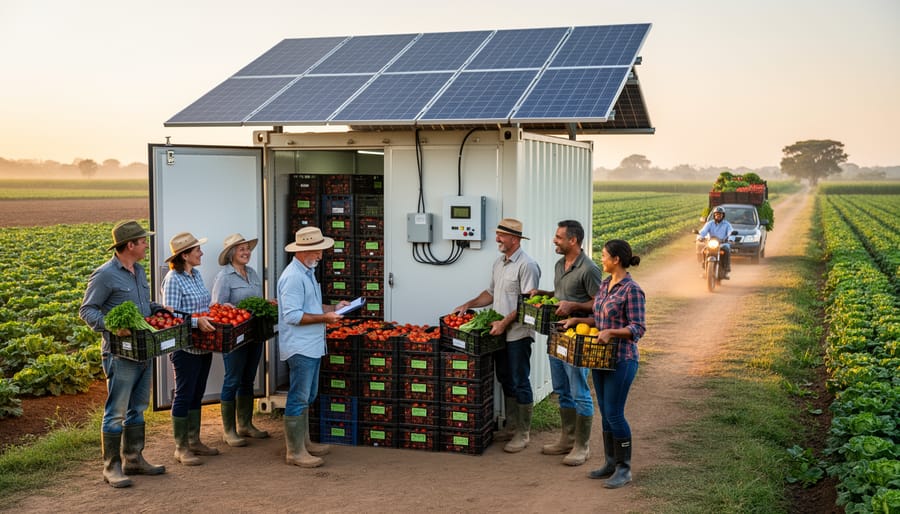
Smallest yet most transformative are mobile solar cold storage units and micro-installations powering single-farmer cooling solutions. Container-sized units equipped with solar panels can be relocated seasonally, following harvest patterns. These serve nomadic herders preserving dairy products or fishing communities storing catches before transport to urban markets.
Each scale addresses specific needs within renewable energy agriculture proving that solar cold storage isn’t a one-size solution but an adaptable infrastructure matching Africa’s agricultural reality.
The Economics: Cost Savings That Transform Farming Businesses
The financial transformation begins with operational cost savings that reshape farming economics. Traditional diesel-powered cold storage systems burden farmers with fuel costs ranging from $0.40 to $0.80 per liter, creating monthly expenses of $500 to $1,200 for a mid-sized facility. Solar-powered alternatives eliminate these recurring fuel costs entirely, replacing them with predictable maintenance expenses averaging just $50 to $150 monthly.
| Cost Category | Diesel-Powered Storage | Solar-Powered Storage |
|---|---|---|
| Initial Investment | $15,000 – $25,000 | $30,000 – $45,000 |
| Monthly Operating Cost | $500 – $1,200 | $50 – $150 |
| Typical Payback Period | Not applicable | 3 – 5 years |
The higher upfront investment in solar infrastructure typically delivers full payback within three to five years through fuel savings alone. Beyond this breakeven point, farmers capture the full operational cost advantage for the system’s 20 to 25-year lifespan. For cooperatives serving multiple farmers, pooled investment models reduce individual capital requirements to $2,000 to $5,000 per member while maintaining access to shared facilities.
Revenue protection adds another economic dimension. Farmers using solar cold storage report 30% to 40% reductions in post-harvest losses, directly translating to increased marketable produce. A smallholder growing $8,000 worth of vegetables annually can preserve an additional $2,400 to $3,200 in product value, often achieving system payback through loss prevention alone before accounting for fuel savings or premium pricing for fresh produce.
Success Stories: Solar Farms Changing African Agriculture
East Africa: Kenya’s Horticultural Export Revolution
Kenya’s horticultural sector generates over $1.3 billion annually in export revenue, but persistent power outages and expensive diesel-powered cooling previously threatened margins for growers shipping roses, green beans, and avocados to European markets. The introduction of solar-powered cold storage facilities near Nairobi’s Jomo Kenyatta International Airport has transformed this dynamic. A 5-megawatt solar farm now powers a 15,000-ton capacity cold storage complex that serves both large commercial farms and smallholder cooperatives, maintaining the 2-8°C temperatures essential for preserving export-grade produce.
Smallholder farmers, who account for 60% of Kenya’s horticultural production, have seen rejection rates drop from 35% to under 10% since gaining access to these solar-cooled facilities. The cooperative model allows farmers to pay per crate stored, eliminating the capital barrier that previously excluded them from temperature-controlled logistics. One cooperative in Naivasha reports members now earn 40% more per harvest because consistent refrigeration maintains quality standards demanded by international buyers. The solar installation eliminates approximately 800 tons of CO2 emissions annually compared to diesel alternatives while cutting operational costs by 65%, savings that translate directly into competitive pricing for smallholder produce on global markets.
West Africa: Nigeria’s Fish and Dairy Preservation Networks
Nigeria’s fish and dairy sectors have experienced measurable gains from solar-powered cold storage networks deployed across both coastal and inland regions. In Lagos State, solar installations now support over 40 cold rooms serving artisanal fishing communities, where previously up to 50% of catches spoiled before reaching market. These facilities maintain temperatures between 0°C and 4°C, extending shelf life from hours to days and enabling fishers to negotiate better prices by avoiding distress sales.
The dairy sector presents similar success. In Kaduna State, cooperative milk collection centers powered by 20kW solar arrays process over 2,000 liters daily from smallholder herders. Before solar refrigeration arrived in 2024, farmers routinely lost 30% of milk production to spoilage during the dry season when traditional cooling methods failed. Now, pasteurization and cold storage occur within two hours of collection, reducing waste to under 5% while opening access to urban markets previously unreachable.
These networks demonstrate how solar infrastructure specifically addresses the preservation challenges of high-value, highly perishable protein sources where grid electricity remains unreliable or absent.
Southern Africa: Solar-Powered Cooperatives in South Africa and Zimbabwe
In South Africa’s Western Cape, farmer cooperatives have pooled resources to build shared solar installations powering multi-user cold storage hubs. These facilities, typically 50-100 kW systems, serve 15-30 smallholder fruit and vegetable producers who previously lacked individual access to reliable cooling. Members pay usage fees based on storage volume, with the cooperative model spreading capital costs and maintenance responsibilities. The Western Cape Wine Trust runs a notable example where grape growers share solar-powered temperature-controlled storage, reducing spoilage by 65% during harvest season.
Zimbabwe presents a compelling case where solar cooperatives support the Zimbabwe recovery of smallholder tobacco and horticulture sectors. In Mashonaland, three tobacco-growing cooperatives installed collective solar arrays powering shared curing barns and cool storage for fresh produce diversification. Each 40 kW installation serves 20-25 farmers, cutting diesel fuel expenses by 80% while enabling year-round vegetable production alongside traditional tobacco cycles. The cooperative ownership structure has proven especially resilient, with members cross-guaranteeing maintenance funds and sharing technical training, creating sustainable operation beyond initial donor support periods.
Overcoming Barriers: Infrastructure and Investment Challenges
Despite the proven benefits of solar-powered cold storage, significant barriers prevent many African farmers from accessing these systems. Understanding these challenges is essential for stakeholders working to scale solar farm infrastructure across the continent.
Grid connectivity presents a paradox. While off-grid solar systems eliminate dependence on unreliable national grids, they also require sophisticated battery storage that increases project costs by 30-40%. In areas with partial grid access, integrating solar farms into existing infrastructure requires regulatory approvals and technical coordination that many developers find prohibitively complex.
Technical expertise shortages compound these problems. Solar cold storage systems demand specialized installation, maintenance, and repair skills that are scarce in rural Africa. A solar farm that powers agricultural facilities needs regular monitoring, inverter servicing, and battery management, capabilities that most farming communities cannot sustain without external support. When equipment fails, replacement parts may take weeks or months to arrive, negating the reliability advantages.
Policy frameworks often lag behind technological possibilities. Many African countries lack clear regulations governing private mini-grids, leaving investors uncertain about licensing, tariff structures, and ownership rights. Inconsistent import duties on solar equipment across different nations increase costs and complicate regional projects. Without supportive policies, such as tax incentives, standardized technical specifications, or guaranteed off-take agreements for excess power, developers struggle to justify the risk of agricultural solar investments.
These barriers are surmountable, but they require coordinated action across financial, technical, and regulatory domains.
The Role of Partnerships in Scaling Solar Agricultural Infrastructure
Scaling solar agricultural infrastructure across Africa demands coordinated action from multiple stakeholders, each bringing critical resources the others lack. No single entity, whether government, development bank, private investor, or farming cooperative, can deploy this infrastructure at the necessary speed and scale alone.
The most successful deployments combine different partnership archetypes, each suited to specific contexts and objectives:
- Public-Private Partnerships (PPP)
- Government provides land access and regulatory support while private companies finance, build, and operate solar farms with guaranteed off-take agreements. Risk-sharing mechanisms protect both public interests and investor returns.
- Blended Finance Models
- Development finance institutions provide concessional capital or guarantees that de-risk projects for commercial investors, lowering capital costs and making solar cold storage economically viable in underserved regions.
- Cooperative Ownership Structures
- Farmer groups collectively own and govern solar installations serving shared cold storage facilities, ensuring community control while pooling resources for economies of scale.
- Build-Own-Operate-Transfer (BOOT) Agreements
- Private developers construct and run solar farms for a defined period, then transfer ownership to communities or governments after capital recovery, ensuring long-term local asset ownership.
In Rwanda, the Scaling Off-Grid Energy programme demonstrates this multi-stakeholder approach. The national government streamlined permitting and provided land tenure clarity, while development banks offered first-loss guarantees. Private solar companies designed and installed systems, and farmer cooperatives managed the resulting cold storage networks. This layered partnership reduced individual stakeholder risk while accelerating deployment timelines from years to months.
Technical assistance partnerships prove equally vital. International agricultural organizations train farmers in cold chain management, engineering firms provide ongoing maintenance support, and research institutions conduct monitoring to demonstrate impact for future financing rounds. These knowledge-transfer relationships ensure infrastructure operates effectively beyond the ribbon-cutting ceremony.
The emerging trend involves anchor-tenant models where large agricultural buyers commit to purchasing stored produce, providing revenue certainty that unlocks financing for solar installations serving surrounding smallholder networks.
What Comes Next: The Future of Solar-Powered Agricultural Value Chains
The convergence of solar technology and agricultural infrastructure is entering an acceleration phase. By 2030, modular solar-plus-storage systems are expected to drop below critical price thresholds, making cold storage economically viable for individual smallholder farmers rather than cooperatives alone. Battery technology improvements, particularly lithium-iron-phosphate and emerging sodium-ion solutions designed for African climate conditions, will extend cold storage operation through consecutive cloudy days without diesel backup.
Artificial intelligence is reshaping how solar-powered facilities operate. Smart sensors now monitor crop conditions in real-time, adjusting temperature and humidity while predicting optimal harvest windows based on market demand. These systems optimize energy consumption patterns, reducing solar farm capacity requirements by 20-30% compared to conventional cold storage. Mobile applications connecting farmers directly to solar-powered collection points are streamlining logistics, cutting the time between harvest and cooling from days to hours.
Policy frameworks are catching up with technical possibilities. The African Continental Free Trade Area agreement is driving harmonized standards for solar agricultural infrastructure, reducing equipment costs through economies of scale. Several governments are introducing feed-in tariffs specifically for agricultural solar installations, while carbon credit mechanisms now recognize avoided food waste as measurable emissions reductions, creating new revenue streams for solar cold storage operators.
Blended finance models combining development capital, commercial investment, and farmer equity are proving replicable across regions. Pay-as-you-store arrangements, where farmers pay per kilogram cooled rather than upfront infrastructure costs, are expanding access rapidly. These innovations support broader sustainable agriculture transitions by making previously impossible crops commercially viable.
The integration of solar farms with processing facilities beyond simple cooling represents the next frontier. Solar-powered washing, sorting, packaging, and even initial processing operations are creating complete off-grid value chains that capture far more economic value at origin, fundamentally restructuring agricultural economics across the continent.
The convergence of solar energy infrastructure and agricultural cold storage represents far more than a technical solution to post-harvest losses. It embodies a fundamental reimagining of how African nations can leverage their most abundant natural resource to address one of their most pressing challenges. Every solar farm powering a cold storage facility is simultaneously creating jobs, stabilizing farmer incomes, reducing food waste, and strengthening food security for communities that have waited too long for such progress.
The evidence is undeniable. From Kenyan horticultural exporters extending their market reach to Nigerian fish cooperatives doubling product shelf life, solar-powered cold storage is delivering measurable impacts today. These aren’t pilot projects demonstrating what might work someday. They’re operational systems proving what works now, creating blueprints that other regions can adapt and scale.
Yet realizing the full potential demands more than recognizing success stories. It requires coordinated action. Governments must prioritize enabling policies and infrastructure investments. Development partners need to align funding mechanisms with on-the-ground realities. Private investors should recognize the substantial returns available in agricultural cold chain solutions. Technology providers must continue innovating to reduce costs and improve accessibility. Farming communities deserve support in organizing cooperatives and accessing financing.
The pathway forward is clear. The question isn’t whether solar farms across Africa can transform African agriculture, it’s how quickly stakeholders will mobilize the resources and collaboration needed to make this transformation universal rather than exceptional. Africa’s farmers have demonstrated their readiness. Now the broader ecosystem must match their commitment with commensurate investment and urgency.