
A solar powered irrigation system uses photovoltaic panels to convert sunlight into electricity that powers water pumps, delivering water from sources like rivers, wells, or boreholes to agricultural fields without relying on grid power or diesel generators. These systems have become essential infrastructure for smallholder farmers and commercial agricultural operations across Africa, where reliable electricity access remains limited but solar irradiance is abundant year-round.
For a continent where agriculture employs over 60% of the workforce yet accounts for only 15% of GDP, the gap between potential and productivity often comes down to water. Traditional irrigation methods require either manual labor, costly fuel, or grid connections that rarely extend to rural farming communities. Solar powered irrigation eliminates these barriers by transforming Africa’s most reliable resource into on-demand water access, extending growing seasons, increasing crop yields by 300% or more, and enabling sustainable agriculture in Africa that doesn’t depend on unpredictable rainfall patterns.
The technology has matured rapidly since 2020. Component costs have dropped by nearly 70%, efficiency ratings have improved, and financing models tailored to African markets have emerged. Today in 2026, solar irrigation installations span from Morocco’s date palm plantations to Kenya’s horticultural zones, from Nigeria’s rice paddies to South Africa’s vineyards. International development agencies, governments, and private sector players have all recognized these systems as critical infrastructure for food security and climate adaptation.
This article explains how solar powered irrigation systems function, breaks down their core components, examines the different system types suited to various agricultural contexts, and profiles real implementations transforming farming communities across the continent. Whether you’re evaluating feasibility for a cooperative, designing rural development programs, or seeking proven solutions to water scarcity, understanding this technology is now essential to Africa’s agricultural future.
What Is a Solar Powered Irrigation System?
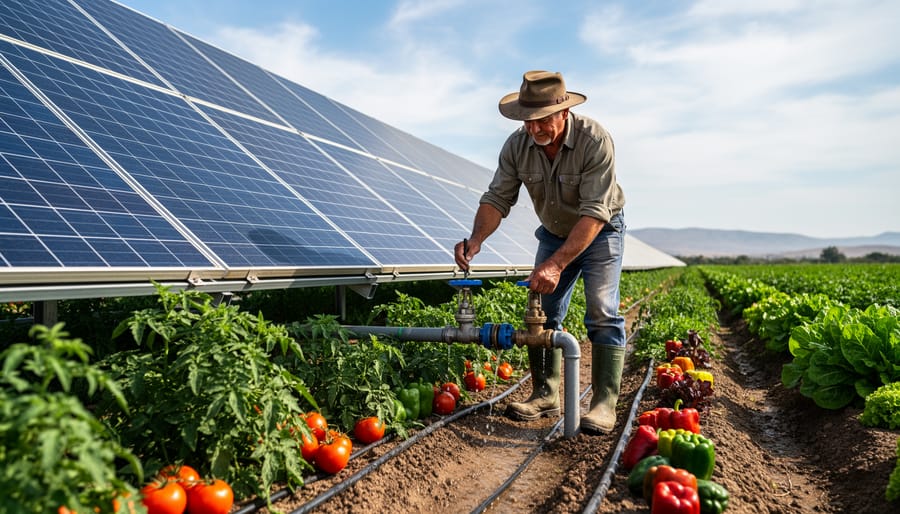
A solar powered irrigation system is agricultural technology that harnesses photovoltaic panels to generate electricity for water pumps, enabling farmers to irrigate their crops using sunlight instead of fossil fuels or manual labor. The system converts solar radiation into electrical energy that drives a pump motor, moving water from underground wells, rivers, boreholes, or reservoirs through pipes and channels directly to agricultural fields.
For African farmers, particularly those in remote rural areas beyond reliable electricity grids, this technology represents a practical pathway to consistent, affordable irrigation. Rather than hauling water manually or depending on expensive diesel generators, farmers can tap into abundant sunlight to power their irrigation needs throughout growing seasons.
The core advantage lies in sustainability and cost structure. While diesel pumps require continuous fuel purchases and manual systems demand exhausting physical labor, solar irrigation eliminates recurring energy expenses after the initial equipment investment. This matters critically in regions where fuel supply chains are unreliable and transportation costs inflate diesel prices far above global averages.
- Photovoltaic (PV) panels
- Solar modules that capture sunlight and convert it into direct current electricity to power the irrigation system.
- Solar pump
- An electric water pump specifically designed to operate on solar-generated power, available in submersible and surface configurations.
- Pump controller
- Electronic device that regulates power flow from panels to pump, optimizing performance and protecting equipment from voltage fluctuations.
- Water source
- The origin point of irrigation water, typically underground aquifers accessed through boreholes, surface water bodies, or constructed reservoirs.
- Distribution system
- Network of pipes, channels, or hoses that carries pumped water from source to crops, compatible with drip, sprinkler, or flood irrigation methods.
- Agrivoltaics
- Integrated approach where elevated solar panels serve dual purposes, generating electricity while providing beneficial crop shade beneath them.
This technology aligns naturally with how sustainable agriculture works reducing carbon emissions while improving food production capacity. For smallholder farmers cultivating one to five hectares and commercial operations alike, solar irrigation offers energy independence that transforms agricultural viability in water-stressed environments across the continent.
How Solar Powered Irrigation Systems Work
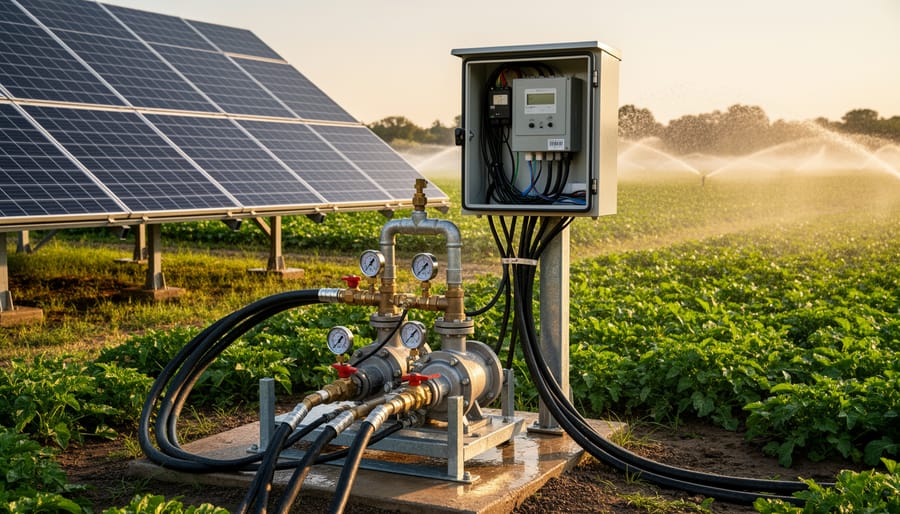
A solar powered irrigation system converts sunlight into mechanical energy to move water from its source to crops. The process begins when photovoltaic panels capture solar radiation and generate direct current electricity through the photovoltaic effect. Individual solar cells within each panel absorb photons, knocking electrons loose from semiconductor material and creating an electrical flow. Multiple panels wired together increase voltage and current capacity to match pump requirements.
The DC electricity flows to a controller or inverter that regulates power delivery to the pump motor. Controllers protect the system from voltage spikes, prevent over-discharge of batteries if present, and optimize pump operation based on available sunlight. In systems using AC pumps, an inverter converts DC power to alternating current at the frequency and voltage the motor requires. Direct-drive systems skip battery storage entirely, running the pump only when sunlight is sufficient, while battery-coupled configurations store excess energy for irrigation during early morning, evening, or cloudy periods.
The electric motor converts electrical energy into rotational force that drives the water pump. Submersible pumps sit underwater in boreholes or wells, pushing water upward through a delivery pipe. Surface pumps remain above ground near rivers or reservoirs, pulling water through an intake line. The pump creates pressure that forces water through distribution infrastructure, whether simple flooding channels, overhead sprinklers, or efficient drip irrigation networks that deliver water directly to plant roots.
System sizing determines how much water the installation can deliver daily. Farmers and technicians calculate total dynamic head, the vertical lift plus friction losses, and required flow rate based on crop water needs, irrigated area, and soil type. The SIP sizing tool manual provides standardized calculations matching pump capacity to solar panel wattage for African conditions. A one-hectare vegetable plot in Kenya might need a 1.5 kilowatt system pumping 30 cubic meters daily, while a five-hectare maize farm in Ethiopia could require 5 kilowatts delivering 100 cubic meters.
Direct-drive systems offer lower cost and simpler maintenance since they eliminate batteries, inverters, and charge controllers. They work well where irrigation timing is flexible and water storage exists at field level. Battery-coupled systems add resilience through off-peak pumping and consistent pressure, but increase upfront investment and introduce components requiring replacement every five to seven years. The choice depends on crop sensitivity to irrigation timing, budget constraints, and whether farmers can adjust schedules to midday pumping windows when solar generation peaks.
Components and Types of Solar Irrigation Systems
Essential System Components
A reliable solar powered irrigation system comprises six interconnected components that work together to convert sunlight into agricultural water delivery. Each element must withstand harsh conditions common across African climates, intense UV radiation, temperature extremes, dust exposure, and occasional moisture intrusion during rainy seasons.
Photovoltaic panels form the power generation core. Monocrystalline panels offer higher efficiency (18-22%) and better performance in partial shade, making them suitable for areas with occasional cloud cover or where agrivoltaic shading occurs. Polycrystalline panels cost less and deliver acceptable efficiency (15-18%) for direct-drive systems in consistently sunny regions. Both types need robust tempered glass and corrosion-resistant aluminum frames to survive decades of exposure.
Water pumps come in three main configurations. Submersible pumps sit below water level in boreholes or wells, protecting them from theft and weather while efficiently handling depths up to 200 meters. Surface pumps draw from shallow wells, rivers, or storage tanks and require weather-proof housing. Floating pumps operate on open water bodies, combining portability with minimal installation requirements. Brushless DC motors outperform AC alternatives in efficiency and longevity.
The complete system requires these additional components:
– Controllers regulate power flow between panels and pump, optimizing performance across varying sunlight conditions
– Inverters convert DC electricity to AC when using conventional AC pumps, though DC systems eliminate this conversion loss
– Mounting structures position panels at optimal angles (typically 10-15 degrees from horizontal in equatorial regions) and must resist wind loads
– Wiring and connections need UV-resistant insulation and waterproof junction boxes rated IP65 or higher
– Distribution infrastructure includes pipes, valves, filters, and emitters sized to match crop water requirements
Quality matters more than initial cost. Tier-1 solar panels with 25-year performance warranties, pumps from established manufacturers with local service networks, and marine-grade wiring prevent the premature failures that plague cheaper installations across Africa.
Types Based on Water Source and Application
Solar powered irrigation systems vary significantly based on where they draw water and how they deliver it to crops. Understanding these configurations helps farmers select the right setup for their specific conditions.
Water Source Configurations
Borehole and well systems use submersible pumps positioned deep underground to extract water from aquifers. These configurations suit areas with limited surface water, particularly across the Sahel and semi-arid regions of East Africa where groundwater remains the most reliable source. The pump lifts water to ground level, where it feeds into distribution networks. Surface water systems draw from rivers, lakes, or streams using floating or shore-mounted pumps. They work well in areas with perennial water bodies, such as the Nile basin or Lake Victoria surroundings. Reservoir-based systems pump water from constructed tanks or ponds, often filling these storage points during peak sunshine hours for later distribution.
Irrigation Method Pairings
Drip irrigation paired with solar pumps delivers water directly to plant roots through tubes and emitters, maximizing efficiency for high-value crops like vegetables, fruits, and flowers. This combination suits smallholder horticulture across Kenya, Ghana, and Rwanda where water conservation matters most. Sprinkler systems distribute water through pressurized spray, covering larger areas for field crops such as maize, wheat, or fodder. Flood irrigation, though less efficient, remains viable for rice paddies in the Nile Delta or wetland agriculture.
Standalone Versus Agrivoltaic Integration
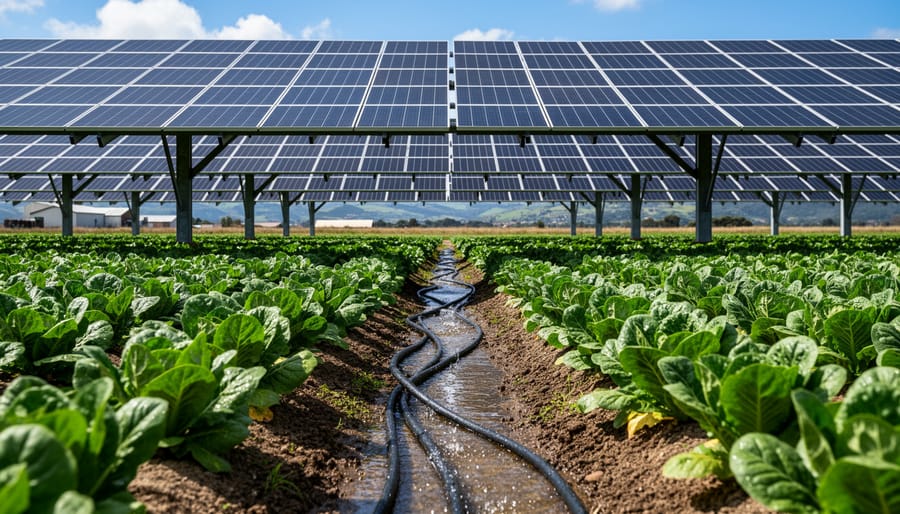
Conventional systems mount panels on dedicated frames near fields. Agrivoltaic installations elevate panels above crops, generating electricity while providing beneficial shade that reduces water loss through evaporation and protects heat-sensitive plants. This dual-purpose approach optimizes scarce land in densely farmed regions of Ethiopia, Senegal, and Morocco, where both energy access and agricultural productivity drive development priorities. The configuration choice depends on farm size, available capital, and whether maximizing land productivity justifies the additional structural investment.
Applications and Uses in African Agriculture
Solar powered irrigation systems serve diverse agricultural needs across Africa, from individual family plots to large-scale commercial operations. Smallholder farmers use compact systems with submersible pumps to irrigate vegetable gardens, enabling year-round production of tomatoes, onions, and leafy greens that previously depended on unpredictable rainfall. These household installations typically range from 500-watt to 2-kilowatt arrays, sufficient to water 0.25 to 2 hectares depending on crop water requirements and local solar resources. In Kenya’s Tharaka-Nithi County, farmers using 1-kilowatt solar drip systems have extended their growing seasons from four to nine months annually, transforming food security for rural households.
Commercial agriculture operations deploy larger installations for horticulture and cash crops, with systems ranging from 5 to 20 kilowatts powering drip and sprinkler networks across 10 to 50 hectares. Flower farms in Ethiopia and vegetable exporters in Senegal have adopted solar irrigation to reduce operational costs while meeting sustainability requirements from European buyers. These commercial systems often include battery storage to maintain consistent irrigation schedules regardless of cloud cover, ensuring crop quality and yield consistency.
Community irrigation schemes represent another vital application, where villages share infrastructure costs and water resources. In Mali’s Ségou Region, cooperative solar pumping stations serve multiple farmers who irrigate rice paddies and millet fields through rotational schedules. This collective approach spreads capital investment across numerous households while building local technical capacity for maintenance and management.
Livestock watering systems provide another practical use, particularly in pastoral regions where cattle, goats, and sheep require reliable water access across vast rangelands. Solar-powered boreholes in Tanzania and Namibia pump water to storage tanks and troughs, eliminating the need for diesel generators in remote grazing areas.
Agrivoltaic installations offer innovative dual-use configurations where elevated solar panels provide both electricity for irrigation pumps and beneficial shade for crops beneath. In the drought-prone Sahel, this approach reduces evaporation rates and heat stress on vegetables and legumes while generating power. Morocco and Burkina Faso have piloted agrivoltaic systems demonstrating 15-20 percent water savings compared to conventional irrigation layouts. East African countries with high agricultural potential but limited land availability are exploring these integrated systems to maximize productivity per hectare, growing crops and generating clean energy simultaneously from the same plot.
Benefits and Challenges for African Farmers
Solar powered irrigation delivers tangible gains for African farmers while introducing real obstacles that require thoughtful solutions. Understanding both sides helps stakeholders plan effective rollouts.
The economic case starts with fuel savings. Diesel pumps consume costly fuel that drains farm budgets month after month, whereas sunlight is free. A farmer in northern Kenya operating a solar system eliminates recurring fuel purchases entirely, redirecting those funds toward seeds, fertilizer, or hired labor. Maintenance demands are minimal compared to diesel engines that need oil changes, filter replacements, and periodic overhauls. Solar panels and pumps have no moving parts exposed to wear, often delivering 20 to 25 years of service with little intervention beyond occasional cleaning and inspection.
Energy independence transforms farming operations. Farmers no longer depend on fuel deliveries that may be delayed or unavailable in remote areas. They irrigate whenever crops need water, not when diesel arrives. This reliability supports sustainability and food security by enabling consistent crop cycles and higher yields. Carbon emissions drop to zero during operation, aligning agricultural practices with climate goals and making energy-saving farming accessible to smallholders.
The barriers, however, are significant. Upfront costs range from $2,000 for a basic smallholder system to over $20,000 for larger installations, sums that exceed most farmers’ available capital. Technical knowledge gaps mean many farmers lack confidence in system sizing, installation, and troubleshooting. Maintenance infrastructure remains thin in rural areas; when an inverter fails, finding a qualified technician or replacement part can take weeks. Access to financing is inconsistent despite growing interest from development banks and microfinance institutions.
Solutions are emerging across the continent. Pay-as-you-go models allow farmers to lease systems with affordable daily or weekly payments, removing the capital barrier. Grant programs from governments and NGOs subsidize installations for smallholder cooperatives. Training initiatives led by organizations like SunCulture and Futurepump build local technical capacity, creating networks of installers and repair technicians. Component supply chains are strengthening as demand grows, with regional distributors stocking common spare parts. These interventions are turning theoretical benefits into practical realities for thousands of African farmers.
Real-World Success Stories Across Africa
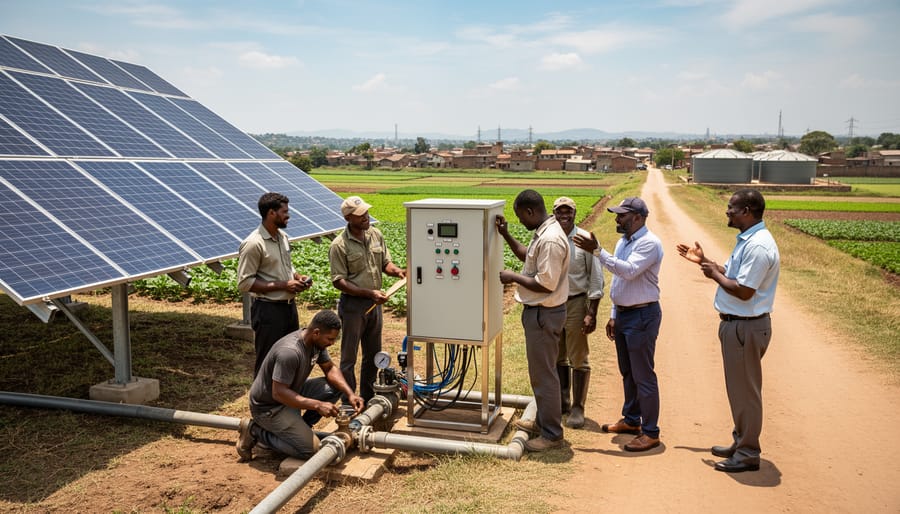
Across Africa, solar powered irrigation systems have moved from pilot projects to proven agricultural solutions, with farmers reporting dramatic improvements in productivity and income.
In Kenya’s arid Turkana County, SunCulture installed over 3,000 solar irrigation systems between 2022 and 2025, enabling smallholder farmers to grow vegetables year-round where rain-fed agriculture had consistently failed. Farmers using the systems reported income increases averaging 300 percent, with some diversifying from subsistence maize to high-value crops like tomatoes and kale. The project combined affordable pay-as-you-go financing with mobile-based technical support, creating a replicable model now expanding to Tanzania and Uganda.
Ethiopia’s Solar Irrigation Development Project, launched in 2023 through partnership between the government and the World Bank, deployed 2,500 systems across Oromia and Amhara regions. The initiative prioritized women-led farming cooperatives and included comprehensive training on system operation, crop management, and financial literacy. Within two growing seasons, participating farms increased yields by 180 percent while eliminating diesel costs that had consumed up to 40 percent of farming income.
Morocco’s Noor Ouarzazate agrivoltaic demonstration farm represents an advanced application, where elevated solar panels generate electricity while shading high-value crops like saffron and aromatic herbs beneath. The dual-use approach increased land productivity by 60 percent compared to conventional farming while producing 2.3 megawatts of clean energy. Researchers documented reduced water requirements due to panel shading and cooler soil temperatures, findings now informing similar projects in Tunisia and Algeria.
Senegal’s Kawsara project in the Casamance region installed community-scale solar irrigation serving 450 rice farmers. The system replaced diesel pumps that frequently broke down during critical growing periods. Cooperative management, supported by GIZ technical assistance, ensured equitable water access and shared maintenance responsibilities, proving that well-structured community ownership can sustain solar irrigation infrastructure long-term.
Common Questions About Solar Powered Irrigation
How much does a solar powered irrigation system cost?
System costs vary widely based on farm size and water requirements, typically ranging from $1,500 for small-scale setups (0.5-1 hectare) to $15,000+ for larger commercial installations. The investment often pays for itself within 3-5 years through eliminated diesel costs and increased crop yields.
What size system do I need for my farm?
Size depends on your daily water requirements, which vary by crop type, climate, and irrigation method. A rough estimate: drip irrigation for one hectare of vegetables might need a 1-2 kW pump with 4-6 solar panels, while flood irrigation or larger areas require proportionally more capacity.
Can solar irrigation work during cloudy days or the rainy season?
Yes, though at reduced capacity, solar panels typically generate 10-25% of peak power under cloudy conditions. Systems with battery storage can irrigate anytime, while direct-drive configurations work best during sunny hours, which often aligns with peak crop water needs.
How long do the components last and what maintenance is required?
Quality solar panels typically last 25+ years, pumps 7-15 years depending on type and usage, and batteries (if included) 3-7 years. Maintenance is minimal: regular panel cleaning, periodic pump inspection, and checking electrical connections, far less demanding than diesel alternatives.
Where can African farmers access financing for these systems?
Options include government subsidy programs, development bank loans, microfinance institutions, pay-as-you-go schemes from private providers, and grants from international organizations. Many countries now offer dedicated renewable energy financing windows specifically for agricultural applications.
Beyond these core considerations, training requirements deserve attention. Most farmers can operate solar irrigation systems without specialized technical knowledge, basic instruction on pump controls and panel positioning typically suffices. However, partnerships with local suppliers who provide installation support and after-sales service prove valuable, particularly for troubleshooting and component replacement.
When comparing solar to diesel pumps, the economics shift dramatically over time. Diesel systems have lower upfront costs but carry ongoing fuel expenses that fluctuate with global oil prices, plus frequent maintenance and shorter lifespans. Solar eliminates fuel costs entirely, operates silently, requires minimal oversight, and provides predictable long-term performance. For remote locations where diesel delivery is expensive or unreliable, solar often becomes the only viable option. The environmental benefits, zero emissions during operation and no fuel spill risks, align with Africa’s climate commitments while improving local air quality around farming communities.
Solar powered irrigation systems represent a pivotal advancement for African agriculture, offering a practical pathway to address both water scarcity and energy poverty simultaneously. As this article has explored, the technology delivers immediate benefits through standalone installations that eliminate diesel dependency and reduce operating costs, while integrated agrivoltaic approaches maximize land productivity by combining food production with clean energy generation beneath elevated solar arrays.
The transformative potential extends beyond individual farms. Successful implementations across Kenya, Ethiopia, Morocco, and Senegal demonstrate that when properly deployed, these systems increase crop yields, strengthen food security, and build climate resilience in vulnerable communities. Smallholders gain reliable access to water without prohibitive fuel expenses, while commercial operations achieve scalable irrigation solutions that align with sustainable farming systems.
Challenges persist, particularly around upfront costs and technical capacity. However, expanding financing mechanisms such as pay-as-you-go models, concessional loans, and grant programs are steadily improving affordability. Training initiatives and stronger supply chains for quality components continue to address knowledge gaps and maintenance concerns.
Scaling adoption requires coordinated action. Governments must strengthen supportive policies and infrastructure. International organizations can amplify funding and knowledge transfer. Private sector innovation drives down costs and improves technology. Farming communities themselves remain central to identifying practical needs and sharing operational insights.
The vision ahead is clear: a continent where farmers harness abundant sunlight to irrigate crops, boost productivity, and secure livelihoods without environmental degradation. As collaboration deepens and technology becomes more accessible, solar powered irrigation stands ready to reshape African agriculture for generations to come.