
Renewable energy agriculture is the integration of renewable power generation, solar, wind, biogas, or hydroelectric systems, directly into farming operations to reduce reliance on fossil fuels, lower energy costs, and boost productivity while supporting environmental sustainability. This approach is reshaping how farms power irrigation, cold storage, processing equipment, and rural communities, particularly in regions where grid electricity remains unreliable or prohibitively expensive.
For Africa, where agriculture employs over 60% of the workforce yet struggles with energy poverty, renewable energy agriculture offers a pathway to transform Africa‘s food systems. The continent receives some of the world’s most abundant solar radiation, paired with strong wind corridors and vast agricultural land. Yet millions of smallholder farmers still rely on diesel pumps, manual labor, and post-harvest losses due to lack of refrigeration. Renewable energy agriculture closes that gap by turning farms into power producers and consumers simultaneously.
This article explains what renewable energy agriculture is, how it works in practice, the main types of systems farmers can deploy, and real-world uses across African agriculture. You’ll see how solar-powered irrigation is expanding crop cycles in Kenya, how biogas digesters in Rwanda convert farm waste into cooking fuel and fertilizer, and why agrivoltaics (combining solar panels with crop production) is gaining traction from South Africa to Morocco.
The shift is not theoretical. Governments, development banks, and private investors are channeling billions into agri-energy projects across the continent. Understanding renewable energy agriculture today means grasping the technology, economics, and policy frameworks that will define African farming for decades to come.
What Renewable Energy Agriculture Means for Farming
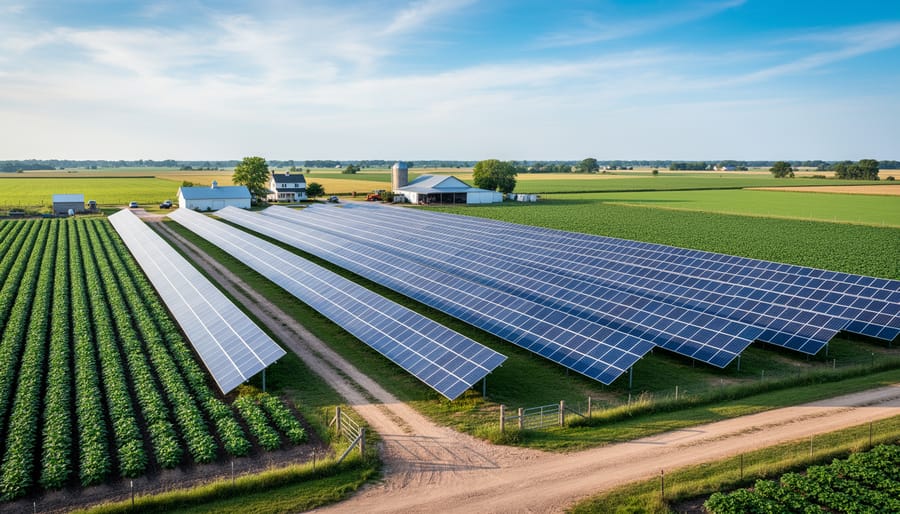
Renewable energy agriculture transforms how farms operate by replacing diesel generators, grid electricity from coal, and biomass stoves with clean energy sources. Instead of relying on expensive, polluting fuels, farmers use solar panels, wind turbines, or biogas digesters to power irrigation pumps, refrigerate harvests, run processing equipment, and meet daily energy needs. This shift cuts operating costs, reduces carbon emissions, and provides reliable power where grid connections are weak or non-existent.
The practice differs fundamentally from conventional farming in two ways. First, it decentralizes energy production: rather than depending on distant power stations or fuel deliveries, farms generate electricity on-site. A solar array on a barn roof can pump water at midday when sun is strongest and crops need irrigation most. Second, it creates synergies between energy and food production. Agrivoltaic systems mount solar panels above crops, providing shade that reduces water evaporation while generating electricity. Wind turbines installed on grazing land allow livestock to graze beneath them, earning farmers rental income without sacrificing pasture.
- Renewable energy agriculture
- The integration of solar, wind, biogas, or other clean energy systems into farming operations to power irrigation, processing, storage, and machinery, replacing fossil fuels.
- Agrivoltaics
- A dual-use system where solar panels are installed above agricultural land, allowing crops to grow or livestock to graze underneath while generating electricity.
- Energy-agriculture nexus
- The interconnected relationship between energy supply and agricultural productivity, where reliable power enables irrigation, cold storage, and processing that increase yields and reduce losses.
- Distributed energy for farms
- On-site power generation using small-scale renewable systems, eliminating dependence on centralized grids or fuel deliveries and providing energy security to rural operations.
This two-way relationship reshapes the economics of farming. A dairy cooperative in Rwanda installs biogas digesters that convert cow manure into cooking fuel, cutting firewood costs while improving sanitation. A maize mill in Kenya adds solar panels and battery storage, processing grain through the night when grid power fails. In Ethiopia’s Rift Valley, wind turbines supply electricity to flower farms that refrigerate blooms for export, maintaining cold chains that preserve quality and fetch premium prices.
The core principle is simple: farms both produce and consume energy, turning agricultural land into dual-purpose assets. This model suits Africa’s scattered, off-grid farming communities, where extending transmission lines is uneconomical but sunlight, wind, and organic waste are abundant. It moves energy infrastructure closer to where food is grown, stored, and processed, breaking the cycle where lack of power limits agricultural potential.
How Renewable Energy Agriculture Works
Energy Generation on the Farm
Solar panels are typically mounted on rooftops of farm buildings, on ground-mounted arrays in marginal areas unsuitable for cultivation, or integrated directly above crops in agrivoltaic systems. In Kenya and Ethiopia, farmers install solar photovoltaic panels near irrigation water sources to minimize transmission losses, with arrays angled to capture optimal sunlight year-round. Seasonal adjustments are rarely necessary in equatorial regions, but in southern Africa, tilt angles may be optimized for winter sun when energy demand for heating and supplementary irrigation peaks.
Wind turbines occupy minimal ground footprint, making them compatible with grazing land and low-density crops. Pastoral communities in northern Kenya and Tanzania install small-scale turbines on elevated terrain to capture prevailing winds, with livestock freely roaming beneath. Turbine foundations and access roads consume less than one percent of usable farmland, allowing dual-use without compromising agricultural productivity.
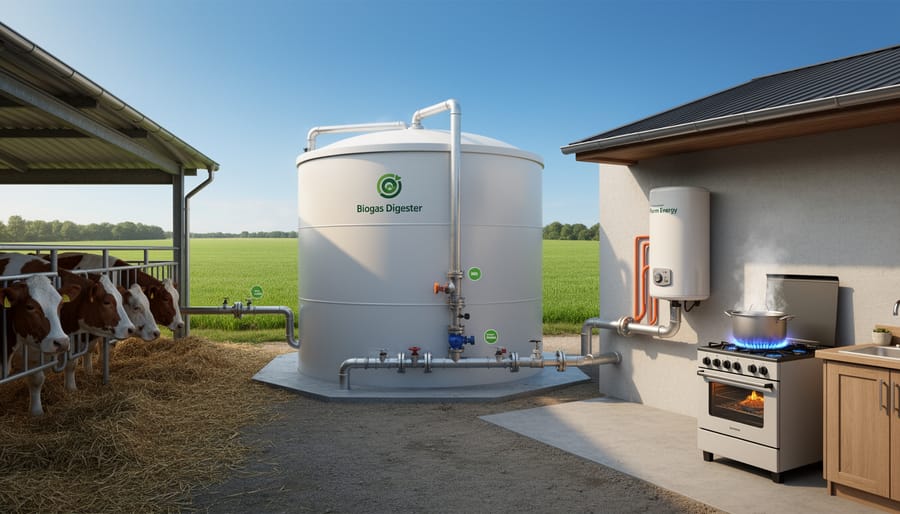
Biogas digesters convert animal manure, crop residues, and organic waste into methane fuel for cooking, heating, and electricity generation. Digesters are positioned near livestock pens or processing areas for convenient feedstock supply and slurry removal. In Rwanda and Uganda, dairy farmers feed manure daily into digesters, producing enough gas for household cooking and pasteurization while generating nutrient-rich fertilizer as a byproduct. The digestion cycle takes 15 to 30 days, aligning with continuous waste production from stabled animals.
Hybrid systems combine solar with battery storage or biogas backup, ensuring energy availability during cloudy periods or nighttime operations. This flexibility matches the irregular timing of farm tasks like early-morning milking and evening processing.
Powering Agricultural Operations
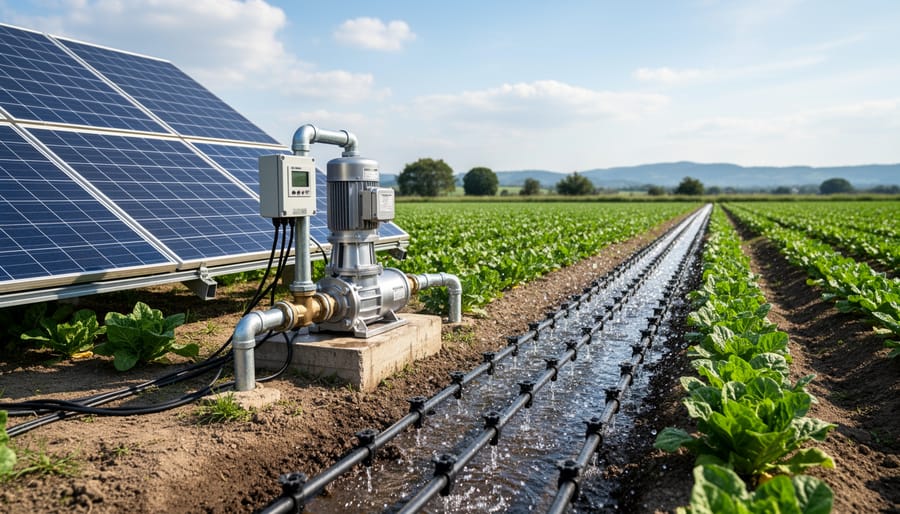
Once renewable energy systems are installed on a farm, the electricity flows directly into the operations that traditionally consumed diesel or grid power, or that were simply impossible without a reliable energy source.
Irrigation systems are often the first beneficiaries. Solar-powered pumps draw water from boreholes, rivers, or reservoirs and deliver it through drip or sprinkler networks, replacing costly diesel engines and manual labor. Farmers can irrigate during peak sunlight hours or store energy in batteries for evening watering, extending growing seasons and boosting yields even in arid regions.
Cold storage and refrigeration transform perishability into profit. Renewable-powered cold rooms preserve dairy, vegetables, and fruits from harvest to market, cutting post-harvest losses that can exceed 30 percent in some African contexts. Solar freezers in fishing communities and dairy cooperatives operate independently of unreliable grids, protecting livelihoods and food quality.
Processing facilities, grain mills, oil presses, coffee pulpers, and maize shellers, run on clean electricity, eliminating fuel costs and enabling value addition at the farm level. Smallholders who once sold raw produce can now mill, package, and sell finished goods, capturing more income.
Greenhouse climate control systems regulate temperature, humidity, and ventilation with precision, creating optimal growing conditions year-round. Poultry farms use renewable energy for lighting, heating, and automated feeders. Dairy operations power milking machines and pasteurizers. Water pumping extends beyond irrigation to livestock watering, cleaning, and domestic use in farm households, improving hygiene and freeing up time for productive work.
Main Types and Models of Renewable Energy Agriculture
Renewable energy agriculture takes several distinct forms in Africa, each adapted to specific farming operations, land conditions, and climate zones. The most widespread model is solar-powered irrigation, which uses photovoltaic panels to run water pumps for crop watering. A solar irrigation system suits regions with high solar irradiance and water stress, common across the Sahel, East Africa, and semi-arid zones, and scales from small drip setups for half-hectare plots to larger pivot systems for commercial horticulture. Solar pumping eliminates diesel costs, reduces emissions, and operates reliably in off-grid areas, making it ideal for smallholders growing vegetables, maize, or cash crops like coffee.
Agrivoltaics, or dual-use solar farming, represents a newer approach where elevated solar panels shade crops or livestock below. Panels are mounted high enough (typically 2.5 to 5 meters) to allow farm machinery to pass underneath, and the partial shade can benefit heat-sensitive crops such as tomatoes, leafy greens, or even staples like sorghum in hot climates. This model works best on land where full sun exposure stresses plants or where livestock need cooling, and it maximizes land productivity by generating electricity while maintaining agricultural output. Pilots in Kenya and South Africa have shown yield gains of 10 to 20 percent under panels in arid conditions, alongside steady electricity revenue.
Biogas systems convert organic farm waste, manure, crop residues, food scraps, into methane for cooking, heating, or electricity generation through anaerobic digestion. They suit livestock operations (dairy, poultry, piggeries) and farms with consistent waste streams. Biogas digesters are cost-effective at medium to large scales, particularly in regions with strong dairy sectors like Rwanda’s highlands or Kenya’s Rift Valley. Byproduct digestate doubles as organic fertilizer, closing the nutrient loop. The technology requires some technical knowledge to maintain but addresses both energy needs and waste management in a single system.
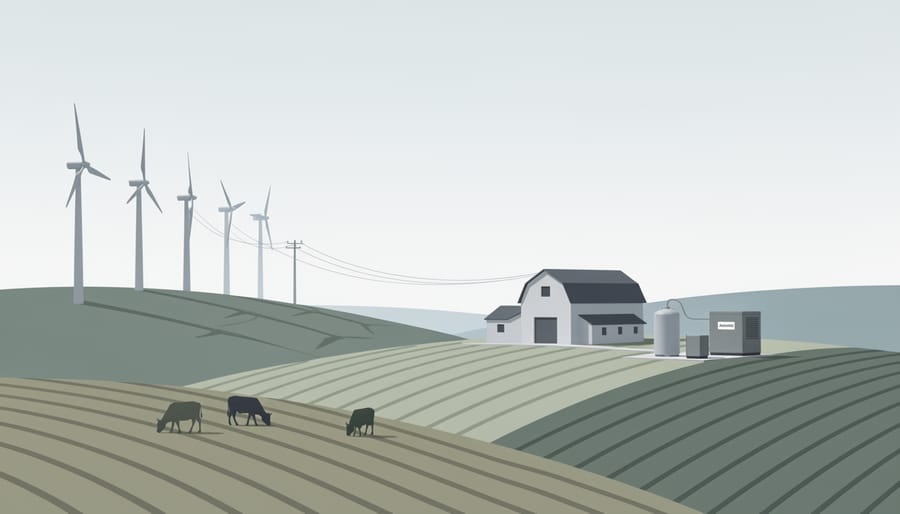
Wind energy on pastoral or grazing land installs turbines on rangeland where they coexist with livestock. Turbines occupy minimal ground space, and cattle or sheep graze freely around the base. This model fits windy highland plateaus or coastal zones, such as parts of Ethiopia, northern Kenya, or South Africa’s Eastern Cape, and supplies electricity for rural communities, processing facilities, or the national grid. It scales well for cooperatives or community-owned projects where land is communal.
Hybrid systems combine two or more sources, solar and biogas, solar and wind, or solar with battery storage, to ensure year-round reliability. They match farms with variable energy demands (daytime irrigation plus evening cold storage) or seasonal production cycles, and they provide resilience against weather variability. Hybrids require higher upfront investment but deliver stable, 24-hour power for value-added processing like milling, refrigeration, or dairy chilling, which are critical for reducing post-harvest losses and accessing premium markets.
How Renewable Energy Agriculture Is Used Across Africa
Across Africa, renewable energy agriculture is moving from pilot projects to proven solutions that address the continent’s most pressing farming challenges. In Kenya’s Rift Valley, solar-powered drip irrigation systems have transformed smallholder vegetable production, enabling farmers to cultivate high-value crops year-round despite erratic rainfall. The systems pump groundwater during daylight hours, storing it in elevated tanks for gravity-fed distribution, eliminating diesel costs that once consumed up to 40% of operational budgets. Similar deployments in Ethiopia’s Tigray region have brought irrigation to previously rain-dependent plots, allowing farmers to extend growing seasons and diversify from subsistence grains to cash crops like tomatoes and peppers.
Cold chain applications demonstrate renewable energy’s direct impact on post-harvest value retention. Rwanda’s dairy cooperatives have installed solar-powered milk cooling tanks at collection centres, cutting spoilage from 25% to under 5% and enabling farmers to access premium urban markets in Kigali. In South Africa’s Western Cape, solar refrigeration units at pack houses preserve the quality of table grapes and citrus during the critical window between harvest and export shipment. These systems pay for themselves within three years through reduced losses and better prices, while eliminating the reliability issues that plague grid-dependent cold storage in areas with frequent power cuts.
Biogas systems convert what was once waste into valuable energy and fertilizer. In Tanzania’s Lake Victoria region, smallholder dairy farmers feed cow manure into simple digesters that produce cooking gas for household use and nutrient-rich slurry for fields. A single digester serving a family with four cows eliminates the need to purchase firewood or charcoal, saving roughly $30 monthly while improving indoor air quality. Larger installations at commercial poultry farms in Nigeria and Ghana generate enough biogas to power on-site processing equipment and sell excess electricity to nearby communities.
Solar water pumping has become the workhorse technology for smallholders across the Sahel and East Africa. In Senegal’s groundnut belt, farmers pool resources to install shared solar pumps serving multiple plots, replacing hand-watering and expensive diesel generators. The pumps operate autonomously, requiring minimal maintenance and no fuel purchases. In northern Ghana, solar boreholes supply water for both irrigation and livestock, anchoring communities that previously migrated seasonally in search of water.
Agrivoltaic pilots, where solar panels and crops coexist on the same land, are emerging in Morocco and South Africa, with shade-tolerant vegetables grown beneath elevated panel arrays. Early results show the panels reduce water evaporation by up to 30% while generating electricity, though these dual-use systems remain more expensive than standalone solar or conventional farming. The model holds particular promise for water-scarce regions where every drop counts and land is not the limiting factor.
Impact of Renewable Farms on African Agriculture
Renewable energy agriculture is reshaping Africa’s farming landscape in profound ways. On the positive side, reliable electricity transforms what smallholders can accomplish. Farms with solar-powered irrigation in Kenya’s Rift Valley now harvest three crops annually instead of one rainy-season yield, tripling income while reducing vulnerability to drought. Cold storage powered by renewables cuts post-harvest losses, a persistent problem that costs African farmers up to 40% of their produce, by preserving milk, vegetables, and fruit until they reach markets at better prices.
Operational costs drop sharply once systems are installed. Diesel pumps, which many farmers previously relied on for irrigation, burn expensive imported fuel and require constant refueling trips. Solar pumps eliminate that recurring expense. Biogas digesters convert livestock waste into cooking fuel, saving families money on firewood or kerosene while reducing indoor air pollution. These savings compound over years, improving household finances and freeing capital for seeds, fertiliser, or equipment.
Renewable farms also advance climate resilience and sustainable agriculture. Solar and wind systems produce zero emissions, helping farms reduce their carbon footprint while adapting to erratic rainfall and rising temperatures. Rural electrification benefits ripple beyond the farm gate: when an agricultural processing facility installs solar capacity, nearby homes and schools often gain access to electricity through local distribution networks. Job creation follows, from installation and maintenance technicians to agro-processing roles that weren’t viable without consistent power.
The challenges, however, are real. Upfront capital costs remain a barrier for smallholders, even as prices fall. A solar irrigation system might cost several thousand dollars, prohibitive without accessible financing, subsidies, or pay-as-you-go models. Land-use competition arises with agrivoltaics and wind farms, particularly in densely populated regions where every hectare matters for food production. While dual-use designs mitigate this, finding the optimal balance requires site-specific planning and negotiation.
Technical skills gaps slow adoption and sustainability. Many rural areas lack trained technicians to install, maintain, or repair renewable systems, leading to equipment sitting idle after minor malfunctions. Policy and regulatory barriers add friction: inconsistent subsidies, unclear grid-connection rules, and import tariffs on solar components make scaling harder. These solar challenges extend across sectors but hit agriculture especially hard, where margins are thin and farmers cannot afford downtime.
Balancing these impacts requires targeted investment in training programs, innovative financing mechanisms, and supportive regulatory frameworks that recognize agriculture’s unique needs.
Frequently Asked Questions
Can smallholder farmers afford renewable energy systems?
Upfront costs remain a barrier, but modular systems allow farmers to start small, a single solar panel for a water pump or phone charging, and expand over time. Pay-as-you-go financing models and community cooperative purchasing reduce individual cost burdens significantly.
What financing and subsidy options exist in Africa?
Many African governments offer grants and tax incentives for renewable energy adoption, while development finance institutions provide concessional loans. Microfinance organizations increasingly support solar and biogas installations, and some countries have feed-in tariff programs that pay farmers for surplus electricity fed into the grid.
Do solar panels compete with crops for space?
Not necessarily. Agrivoltaic systems mount panels high enough to allow crops or grazing underneath, and in arid regions partial shading can actually reduce water stress for certain plants. Many installations utilize marginal land, rooftops, or field edges rather than prime growing areas.
How does renewable energy improve food security?
Reliable electricity enables year-round irrigation, extends growing seasons, powers cold storage that prevents post-harvest losses, and supports on-site processing that adds value to crops. These capabilities directly increase both the quantity and quality of food reaching markets and households.
What skills are needed to maintain these systems?
Basic electrical knowledge and equipment-specific training suffice for routine maintenance. Most suppliers provide initial training, and regional technical colleges increasingly offer renewable energy courses. Community maintenance models share expertise across multiple farms, reducing the skill burden on individual operators.
How long do renewable energy systems last on farms?
Solar panels typically carry 25-year warranties and often function longer, while biogas digesters can operate for decades with proper care. Wind turbines generally have 20-year lifespans, and battery storage systems usually require replacement every 5-10 years depending on usage patterns and technology type.
Understanding how solar powers irrigation helps clarify one of the most common entry points for farmers exploring renewable energy options. The technical simplicity of connecting panels to existing pumps makes solar irrigation an attractive first investment, particularly in water-scarce regions where diesel costs consume a significant portion of farm budgets.
The financing landscape continues to evolve rapidly. Mobile money platforms have enabled new payment models where farmers pay small daily or weekly amounts for solar equipment they use but do not immediately own, removing the capital barrier entirely. Several West African countries now mandate that a percentage of rural electrification funds support agricultural energy needs, creating direct pathways for farmer applications.
Renewable energy agriculture stands at the crossroads of Africa’s two most pressing development priorities: achieving energy security and transforming agricultural productivity. By integrating solar, wind, and biogas systems into farming operations, this approach addresses both challenges simultaneously, offering a practical pathway toward food security, rural prosperity, and climate resilience.
The dual opportunity is clear. Renewable energy systems reduce farmers’ dependence on expensive, polluting diesel generators and unreliable grid connections, cutting operational costs while powering irrigation, cold storage, and processing facilities that prevent post-harvest losses. At the same time, these installations generate clean electricity that can electrify entire rural communities, creating ripple effects far beyond individual farms. For a continent where 600 million people still lack electricity and agriculture employs over half the workforce, this convergence represents genuine transformation rather than incremental improvement.
Success at scale demands coordinated action. Governments must establish supportive policies that reduce upfront capital barriers, streamline permitting, and incentivize private investment. Financial institutions need to develop accessible loan products tailored to smallholder contexts. Technology partners should prioritize designs suited to African climates and farming systems, while training programs build the technical capacity required for long-term maintenance.
The tools exist. The models are proven. What remains is translating scattered pilots into widespread adoption, turning renewable energy agriculture from an emerging concept into the standard practice that powers Africa’s agricultural future.