
Sustainable agriculture in Africa refers to farming practices that meet current food needs while preserving natural resources, supporting rural livelihoods, and building resilience against climate change for future generations. Unlike conventional methods that deplete soil and rely heavily on chemical inputs, sustainable approaches integrate ecological principles, renewable technologies, and indigenous knowledge to produce food efficiently across the continent’s diverse landscapes.
Africa faces a unique agricultural crossroads in 2026. The continent holds 60 percent of the world’s uncultivated arable land, yet food insecurity affects millions. Climate volatility has intensified, with shifting rainfall patterns and rising temperatures threatening traditional farming calendars. At the same time, Africa’s population continues to grow rapidly, projected to reach 2.5 billion by 2050, placing unprecedented pressure on food systems.
Sustainable agriculture offers a practical path forward by working with natural systems rather than against them. Solar-powered irrigation pumps replace diesel generators in Kenya’s smallholder farms. Agroforestry systems in Malawi restore degraded soil while producing multiple crop yields. Conservation farming techniques in Zambia triple maize production without expanding land use. These aren’t experimental concepts but proven methods already transforming yields and incomes across the continent.
This article explains how sustainable agriculture operates within African contexts, the specific practices and technologies driving change, and the real-world applications reshaping food production from the Sahel to Southern Africa. Whether managing a cooperative farm in Ethiopia or designing agricultural policy in Nigeria, understanding these systems has become essential. The integration of renewable energy solutions into farming practices demonstrates how agriculture sits at the heart of Africa’s broader transition toward sustainable development, creating food security and economic opportunity while protecting the environment that makes both possible.
Defining Sustainable Agriculture in the African Context
Sustainable agriculture in Africa represents a farming approach that balances productivity with long-term ecological stability, economic viability, and social fairness. Unlike conventional intensive farming models designed for temperate climates with predictable rainfall and industrial infrastructure, African sustainable agriculture adapts to the continent’s diverse ecosystems, erratic weather patterns, and predominantly smallholder farming structures. It acknowledges that 60% of Africa’s population depends directly on agriculture for their livelihoods, making farming practices inseparable from community wellbeing and food sovereignty.
The framework rests on three interconnected pillars. Environmental health emphasizes soil regeneration, water conservation, and biodiversity preservation, critical in regions facing desertification and declining fertility. Economic profitability ensures farmers can sustain their families and invest in improvements, moving beyond subsistence toward resilient household economies. Social equity addresses land access, gender inclusion, and knowledge transfer, recognizing that women perform 60-80% of agricultural labor yet often lack decision-making power or resource control.
Africa’s agricultural landscape presents distinct challenges that shape sustainable approaches. Climate variability has intensified, with prolonged droughts in the Sahel and Horn of Africa alternating with flooding in coastal and equatorial zones. Soil degradation affects nearly 500 million hectares across the continent, driven by erosion, nutrient depletion, and poor management practices inherited from colonial commodity production systems. Water scarcity constrains farming potential in two-thirds of African farmland, where rainfed agriculture dominates and irrigation infrastructure remains limited.
The smallholder context fundamentally influences how sustainability functions here. With average farm sizes under two hectares and limited access to credit, mechanization, or synthetic inputs, African farmers have historically employed low-external-input methods by necessity rather than ideology. Sustainable agriculture formalizes and improves these practices through scientific validation, community knowledge exchange, and targeted support.
- Agroecology
- Farming approach that applies ecological principles to agricultural systems, emphasizing biodiversity, nutrient cycling, and natural pest control rather than external chemical inputs. In Africa, it builds on traditional intercropping and rotational practices while incorporating modern understanding of soil biology and ecosystem services.
- Climate-Smart Agriculture
- Farming methods designed to increase productivity, strengthen resilience to climate shocks, and reduce greenhouse gas emissions where feasible. African applications focus heavily on drought-resistant crops, improved water management, and diversification strategies that buffer against weather extremes.
- Integrated Farming Systems
- Holistic farm management that combines crops, livestock, trees, and aquaculture in mutually beneficial arrangements. Common African examples include using livestock manure to fertilize crops, crop residues to feed animals, and nitrogen-fixing trees to restore soil fertility while providing fuel and fodder.
- Conservation Agriculture
- Practice based on minimal soil disturbance, permanent ground cover through mulching or cover crops, and diverse crop rotations. Particularly relevant in semi-arid African regions where maintaining soil moisture and preventing erosion determine harvest success.
This African-specific interpretation rejects one-size-fits-all solutions, instead recognizing that sustainable practices in Rwanda’s terraced highlands differ markedly from those in Kenya’s arid northern rangelands or Nigeria’s humid forest zones. Success depends on matching techniques to local agroecological conditions, cultural practices, and available resources rather than importing external models wholesale.
How Sustainable Agriculture Works in Africa
Integration of Renewable Energy in Agricultural Systems
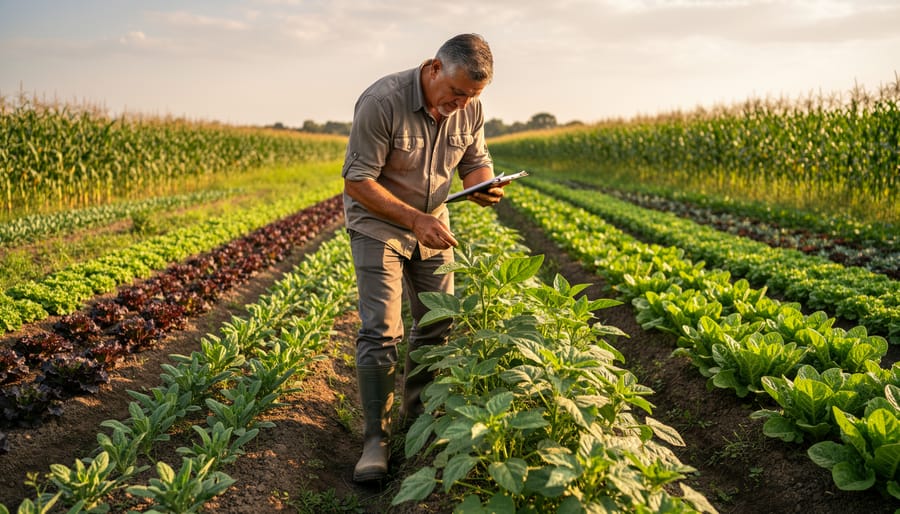
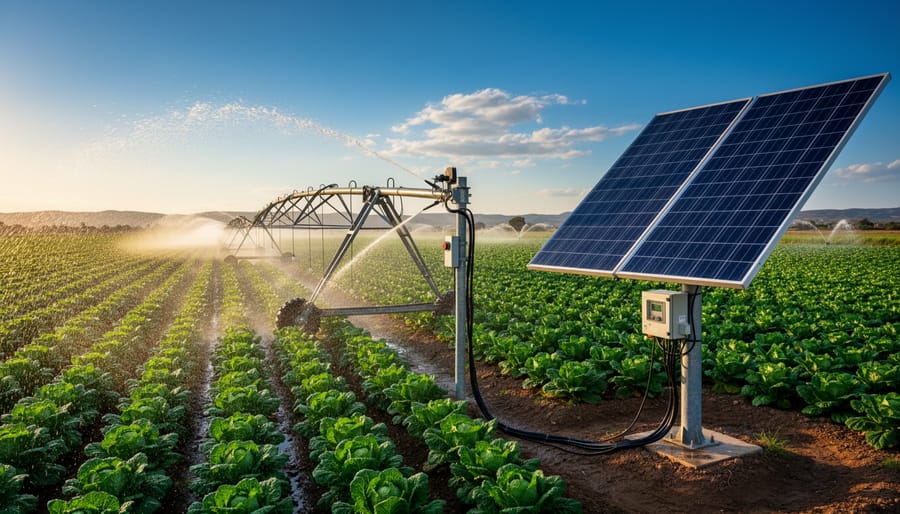
Solar irrigation has emerged as a transformative technology for African farmers, particularly in regions where grid electricity remains unreliable or nonexistent. Photovoltaic panels power water pumps that draw from wells, rivers, or boreholes, enabling year-round cultivation and multiple growing seasons. This reduces dependence on rain-fed agriculture and diesel-powered pumps, cutting both costs and carbon emissions. Countries like Kenya, Morocco, and Senegal have witnessed substantial adoption, with smallholders reporting productivity increases of 30 to 50 percent.
Biogas systems convert agricultural waste, livestock manure, and crop residues into cooking fuel and electricity, addressing energy poverty while managing waste sustainably. The digestate left after biogas production serves as nutrient-rich fertilizer, closing the loop in farm nutrient cycles. Farms in Ethiopia, Tanzania, and Nigeria have installed community-scale biogas plants that power cold storage, processing facilities, and household needs.
Wind power, though less widespread in agriculture than solar, supports irrigation and grain milling in coastal and high-altitude areas with consistent wind patterns. Small wind turbines complement solar arrays, providing power during cloudy periods or at night. These renewable energy sources reduce operational costs, increase farm resilience, and align with Africa’s broader energy transition goals, making sustainable agriculture economically viable while cutting greenhouse gas emissions.
The Role of Traditional Knowledge and Innovation
African farmers have practiced sustainable agriculture for generations through crop rotation, intercropping, and indigenous seed varieties adapted to local climates. These time-tested methods form the foundation of resilience that modern innovations now enhance rather than replace.
Today’s most successful approaches blend ancestral wisdom with contemporary technology. In Ethiopia’s highlands, farmers use traditional terracing techniques alongside mobile apps that provide localized weather forecasts and pest alerts. Kenyan communities combine indigenous knowledge of drought-resistant crops with precision agriculture tools that optimize planting schedules.
The innovation lies not in discarding proven practices but in amplifying their effectiveness. Digital platforms now document oral farming knowledge previously passed down through families, making it accessible across regions. Remote sensing technology helps identify which traditional crop varieties perform best under changing climate conditions. Solar-powered storage facilities preserve indigenous seeds that have sustained communities through past droughts and floods.
This hybrid approach proves particularly valuable for smallholders who cannot afford to abandon methods they trust. A farmer in Senegal might maintain traditional millet varieties while adopting drip irrigation funded through community microfinance. The result is agricultural systems that respect cultural heritage while building capacity to withstand future climate pressures.
Water Management and Conservation Techniques
Water scarcity ranks among Africa’s most pressing agricultural constraints, making strategic water management essential for sustainable farming success. Rainwater harvesting captures and stores precipitation through simple systems like roof catchments or more complex earth dams and underground tanks, providing irrigation reserves during dry periods when crops need it most. This technique proves particularly effective in semi-arid regions where rainfall is unpredictable.
Drip irrigation delivers water directly to plant roots through networks of tubes and emitters, reducing consumption by 40-60% compared to flood irrigation while increasing yields. Solar-powered drip systems have gained ground across East and Southern Africa, eliminating fuel costs for smallholders. The technology prevents water loss through evaporation and allows precise nutrient delivery alongside irrigation.
Watershed management takes a landscape approach, treating entire catchment areas as integrated systems. Farmers use contour bunding, terracing, and vegetation barriers to slow water runoff, increase soil infiltration, and prevent erosion. These techniques recharge groundwater supplies and maintain stream flows downstream, benefiting entire communities rather than individual farms alone.
Types and Components of Sustainable Agriculture in Africa
Agroforestry Systems
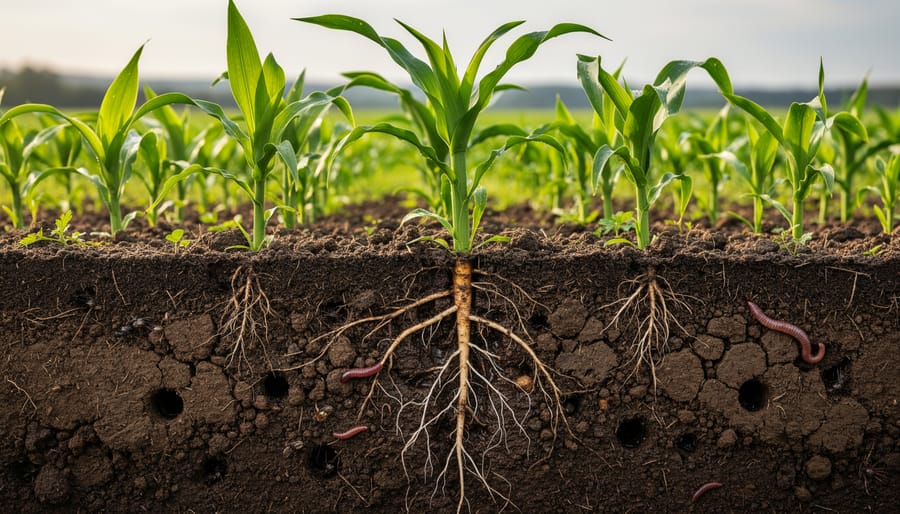
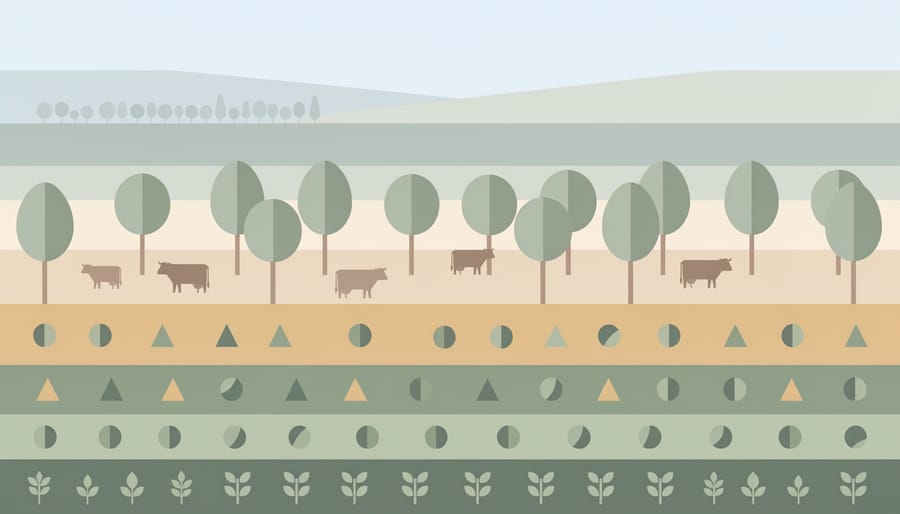
Agroforestry systems combine trees, crops, and sometimes livestock within the same land area, creating multi-layered farming ecosystems that mirror natural forests. In East Africa, farmers plant nitrogen-fixing trees like acacia and leucaena alongside maize and beans, while West African cocoa producers maintain shade trees that protect coffee and cocoa plants from harsh sun. The tree roots penetrate deep soil layers, bringing up nutrients that shallow-rooted crops can’t reach, while fallen leaves add organic matter that feeds soil microorganisms. Studies have quantified soil health benefits including increased carbon content and improved water retention in agroforestry plots compared to monoculture fields.
These systems sequester carbon both above and below ground, mature trees in Ethiopian coffee forests store three to four times more carbon than annual crops alone. The structural diversity creates habitat for pollinators, pest predators, and birds that control crop-damaging insects. Kenya’s grevillea-maize systems produce timber revenue alongside food crops, while Sahel farmers use Faidherbia albida trees that drop leaves during the growing season, fertilizing crops without competing for sunlight. This approach turns farms into productive ecosystems rather than simplified monocultures.
Conservation Agriculture
Conservation agriculture represents a practical shift from conventional tillage-based systems that have depleted African soils for decades. It rests on three interconnected principles: minimal mechanical soil disturbance (ideally no-till or reduced tillage), permanent organic soil cover using crop residues or cover crops, and diversified crop rotations that break pest and disease cycles. By leaving the soil structure intact, farmers preserve beneficial organisms, improve water infiltration, and reduce erosion, critical advantages in regions facing erratic rainfall and degraded farmland.
Southern Africa has become a testing ground for these methods, with Zimbabwe, Zambia, and parts of South Africa reporting yield increases of 20-50% among smallholders who’ve adopted conservation agriculture over three to five seasons. Farmers there use hand-held jab planters to seed directly through mulch layers, cutting labour costs while building soil organic matter year after year. Southern Africa case studies document how maize-legume rotations under permanent cover consistently outperform ploughed fields during droughts, giving households a buffer against climate shocks. The challenge lies in shifting mindset: generations have equated bare, tilled soil with readiness to plant, so extension programs focus on demonstration plots and farmer-to-farmer learning to build trust in what looks, at first glance, like untended ground.
Integrated Pest Management
Integrated Pest Management (IPM) offers African farmers a science-based alternative to blanket pesticide application by combining biological controls, cultural practices, and targeted interventions only when needed. Farmers release natural predators like parasitic wasps to control crop-damaging insects, plant pest-repellent crops alongside cash crops, and monitor fields regularly to catch infestations early before they spread. IPM reduces pesticide use by up to 70 percent in some African contexts while maintaining or improving yields, cutting input costs for smallholders who spend significant portions of their income on chemicals. In Kenya’s horticultural zones, farmers using IPM strategies report healthier soils, increased beneficial insect populations, and better market access as European buyers demand lower pesticide residues.
Climate-Smart Agriculture
Climate-smart agriculture represents a strategic approach that simultaneously tackles three objectives: boosting crop yields, building resilience against increasingly unpredictable weather patterns, and lowering emissions from farming activities. In practice, this means selecting drought-tolerant crop varieties that maintain productivity during dry spells, adjusting planting calendars based on updated rainfall forecasts, and adopting practices like mulching to retain soil moisture while reducing the need for frequent tillage. Many African farmers are incorporating legumes into rotation systems to naturally fix nitrogen in the soil, cutting reliance on synthetic fertilizers that contribute to emissions. Where feasible, biogas digesters convert livestock manure into clean cooking fuel and nutrient-rich fertilizer, closing waste loops. The approach isn’t about wholesale transformation, it’s about layering small, evidence-based adjustments that collectively strengthen farms against climate shocks while maintaining or improving food production for communities that can least afford crop failures.
Organic Farming and Permaculture
Organic farming eliminates synthetic pesticides and fertilizers, relying instead on compost, green manure, and biological pest control. Across Africa, certification programs like the East African Organic Products Standard enable farmers to access premium export markets in Europe and Asia, where demand for African organic coffee, cocoa, and cotton continues to grow. Permaculture takes a broader approach, designing whole-farm ecosystems that mimic natural patterns, layering fruit trees with vegetables and legumes, capturing water through swales and ponds, and integrating livestock to cycle nutrients. In Kenya and Uganda, permaculture training centers teach smallholders to transform degraded plots into productive food forests that require minimal external inputs. While transition costs and certification fees pose barriers, farmer cooperatives and domestic consumer awareness in South Africa, Nigeria, and Ghana are creating viable local markets for organic produce, reducing dependence on expensive imports and external certification.
Uses and Applications Across African Regions
Smallholder Farming Transformation
Smallholder farmers cultivate roughly 80% of Africa’s farmland, yet many struggle with declining soil fertility, unpredictable rainfall, and limited access to inputs. Sustainable practices offer these farmers practical pathways to increase productivity without expensive chemicals or equipment.
Conservation agriculture techniques like mulching and crop rotation have doubled maize yields for smallholders in Zambia and Kenya while cutting labor demands by 30%. These methods work because they rebuild soil organic matter, improve water retention, and reduce erosion, addressing root causes rather than masking symptoms with fertilizers.
Agroforestry systems allow farmers to diversify income streams by intercropping staple crops with fruit trees, timber species, or nitrogen-fixing plants. A farmer in Malawi growing pigeon peas alongside maize adds a protein crop, fixes soil nitrogen, and earns extra income from pulse sales, all from the same plot.
Solar-powered drip irrigation systems, now affordable through mobile payment plans in countries like Rwanda and Tanzania, extend growing seasons and enable vegetable production during dry months. Farmers using these systems report income increases of 40-60% through year-round cultivation and reduced water waste.
Commercial and Export Agriculture
Large-scale agricultural enterprises across Africa are increasingly embracing sustainable certification schemes and practices, driven by both market demands and the business case for long-term viability. Export-oriented operations producing coffee, tea, cocoa, flowers, and horticultural products now pursue certifications like Fairtrade, Rainforest Alliance, and organic standards to access premium markets in Europe, North America, and Asia.
Kenya’s flower industry demonstrates this shift, with major growers implementing integrated pest management, water recycling systems, and solar-powered cold storage to meet strict sustainability requirements from European retailers. Ethiopian coffee cooperatives have adopted shade-grown agroforestry systems that preserve biodiversity while commanding higher prices through specialty coffee markets.
Commercial farms are discovering that sustainable practices reduce input costs over time. Precision agriculture technologies, including solar-powered sensors and drip irrigation, cut water and fertilizer use by up to 40% while maintaining yields. Cover cropping and reduced tillage improve soil health, decreasing dependence on synthetic amendments.
The transition isn’t without challenges. Certification costs, technical training requirements, and initial investment in infrastructure create barriers, particularly for medium-sized operations. However, forward-thinking producers recognize that sustainability credentials are becoming non-negotiable for maintaining market access as international buyers tighten procurement standards around environmental and social performance.
Urban and Peri-Urban Agriculture
Africa’s urban population is projected to double by 2050, making cities crucial frontiers for sustainable food production. Urban and peri-urban agriculture transforms vacant lots, rooftops, and city peripheries into productive growing spaces that supply fresh vegetables, herbs, and even fish to local markets within hours of harvest.
In Nairobi, vertical gardens and container farming allow residents to grow leafy greens on balconies and small plots, reducing transportation costs and food waste. Peri-urban farms on city outskirts use solar-powered drip irrigation and organic composting from municipal waste, creating closed-loop systems that address both food security and waste management.
These urban systems typically focus on high-value, fast-growing crops like tomatoes, spinach, and kale that meet immediate consumer demand. Aquaponics installations in cities like Accra combine fish farming with vegetable production, using 90% less water than conventional agriculture while creating year-round protein and produce sources.
Urban agriculture also provides employment for youth and women, strengthens community resilience during supply disruptions, and helps cities adapt to climate impacts by cooling buildings and managing stormwater runoff through green infrastructure.
Success Stories and Case Studies
Across the continent, farmers and communities are transforming food production through sustainable methods that deliver measurable results. In Kenya’s Machakos County, once considered an environmental disaster zone due to severe erosion, smallholder farmers adopted terracing, agroforestry, and rainwater harvesting over the past three decades. The region now supports productive farms with improved soil fertility and increased yields, demonstrating how coordinated local action can reverse land degradation. This transformation came through farmer-to-farmer knowledge sharing, microfinance support, and government extension services working together.
Rwanda’s agricultural revolution offers another compelling example. Following the 2008 Crop Intensification Program, the government partnered with international organizations to promote conservation agriculture, improved seed varieties, and watershed management. Coffee cooperatives integrated shade trees and organic composting while installing solar-powered processing equipment. These cooperatives now command premium prices in international markets, with farmers reporting income increases of 40 to 60 percent alongside reduced environmental impact.
In Ethiopia’s Tigray region, despite recent setbacks, decades of sustainable land management have shown what coordinated effort achieves. Communities constructed thousands of kilometers of stone terraces, established community-managed exclosures allowing vegetation regeneration, and implemented area closures during regeneration periods. The result: groundwater tables rose, soil erosion decreased by up to 70 percent in participating watersheds, and crop productivity improved significantly. The model relied on food-for-work programs initially, then transitioned to community ownership.
West Africa’s Sahel region demonstrates climate-smart agriculture at scale. Niger’s farmer-managed natural regeneration movement has greened over 5 million hectares since the 1980s. Farmers protect and nurture tree stumps and roots rather than clearing them, creating parkland systems that provide fodder, firewood, improved soil fertility, and crop yields 15 to 30 percent higher than cleared fields. This indigenous technique, supported by NGO facilitation and policy changes recognizing farmers’ tree rights, spread across Burkina Faso, Mali, and Senegal.
Solar-powered irrigation is revolutionizing farming in multiple countries. In Senegal, a partnership between a Netherlands development organization and local cooperatives installed 400 solar irrigation systems, enabling year-round vegetable production. Women’s cooperatives gained economic independence, nutritional diversity improved, and diesel fuel costs disappeared. Similar initiatives in Tanzania, Ghana, and Zambia combine drip irrigation with solar pumps, cutting water use by 50 percent while expanding productive growing seasons. These projects integrate technical training, financing mechanisms, and market linkages, proving sustainable agriculture succeeds when supported holistically rather than through technology alone.
Common Questions About Sustainable Agriculture in Africa
Implementing sustainable agriculture across Africa raises practical questions from farmers, investors, and development partners navigating this transition. Understanding the real-world challenges and solutions helps stakeholders make informed decisions about adopting these practices.
What are the initial costs of transitioning to sustainable agriculture?
Initial investments vary widely depending on the practices adopted, but many techniques like composting and crop rotation require minimal capital. Renewable energy systems and irrigation infrastructure need upfront investment but generate long-term savings and productivity gains.
How long does it take to see results from sustainable practices?
Soil health improvements typically show within 2-3 growing seasons, while productivity increases often appear in the first year for practices like improved water management. Long-term benefits compound over 5-10 years as ecosystems stabilize and resilience builds.
Can smallholder farmers afford to adopt these methods?
Many sustainable practices reduce input costs and work within existing resource constraints. Community-based training, farmer cooperatives, and microfinance programs help smallholders access knowledge and resources needed for the transition.
What support is available for farmers making the transition?
Government extension services, NGO partnerships, and international development programs provide training, demonstration plots, and financial assistance. Regional agricultural networks facilitate knowledge sharing and access to markets for sustainably produced goods.
Beyond these common concerns, scalability remains a central question. Sustainable agriculture scales effectively when policies support farmer education, access to appropriate technology, and market linkages that reward sustainable production. Countries like Ethiopia and Kenya demonstrate that national programs combining technical assistance with financial incentives accelerate adoption rates significantly.
The challenge of measuring success also comes up frequently. Farmers and funders need clear indicators beyond yields, including soil organic matter content, water retention capacity, biodiversity markers, and household income stability. These metrics provide a fuller picture of how sustainable systems build resilience against climate shocks while improving livelihoods.
Policy alignment matters too. Agricultural subsidies, land tenure security, and market access policies either enable or hinder sustainable transitions. Forward-thinking governments are reforming incentive structures to favour practices that protect natural resources rather than deplete them, creating an enabling environment where sustainable agriculture becomes the economically rational choice for farmers across all scales of operation.
Sustainable agriculture represents more than an alternative farming method for Africa, it offers a pathway to transform the continent’s food systems, economies, and environmental future. By integrating renewable energy with traditional knowledge and innovative practices, African nations can build agricultural systems that feed growing populations while protecting the ecosystems they depend on.
The evidence from across the continent demonstrates that sustainable agriculture works. Smallholder farmers are increasing yields and incomes through conservation techniques. Commercial operations are accessing premium export markets with certified sustainable products. Urban communities are producing fresh food closer to consumers. These successes share common elements: collaboration between governments and communities, investment in appropriate technology, and commitment to practices that serve people and planet together.
Scaling these achievements requires coordinated action. Policymakers must create enabling environments through supportive regulations, subsidies for renewable energy infrastructure, and extension services that reach rural areas. International organizations and development partners should align funding with on-the-ground realities rather than imported models. Private sector actors can invest in supply chains that reward sustainable practices and create market opportunities for African producers.
The integration of renewable energy into agricultural systems deserves particular attention. Solar irrigation, biogas generation, and efficient processing facilities reduce costs while cutting emissions, a dual benefit that strengthens both farm economics and climate resilience.
Africa’s agricultural transformation is underway. The question is not whether sustainable practices will shape the continent’s food future, but how quickly stakeholders can work together to make them the norm rather than the exception.